The Role of Temporal Hierarchy in Spiking Neural Networks
Published in ArXiv, 2024
Drawing inspiration from cortical features
The mammalian cortex is organized as a hierarchy of time scales: neural activity becomes progressively slower from sensory to association areas, a pattern observed consistently across species. Whether this property is merely a biological curiosity or carries genuine computational benefits for artificial systems is an open question. We investigate this through Spiking Neural Networks (SNNs), which are uniquely suited for this study: as biologically inspired models with inherent temporal dynamics, SNNs offer multiple mechanisms for computing in time, including neuronal time constants, synaptic delays, and recurrent connectivity — each offering a distinct “knob” for controlling the speed of temporal processing across layers.
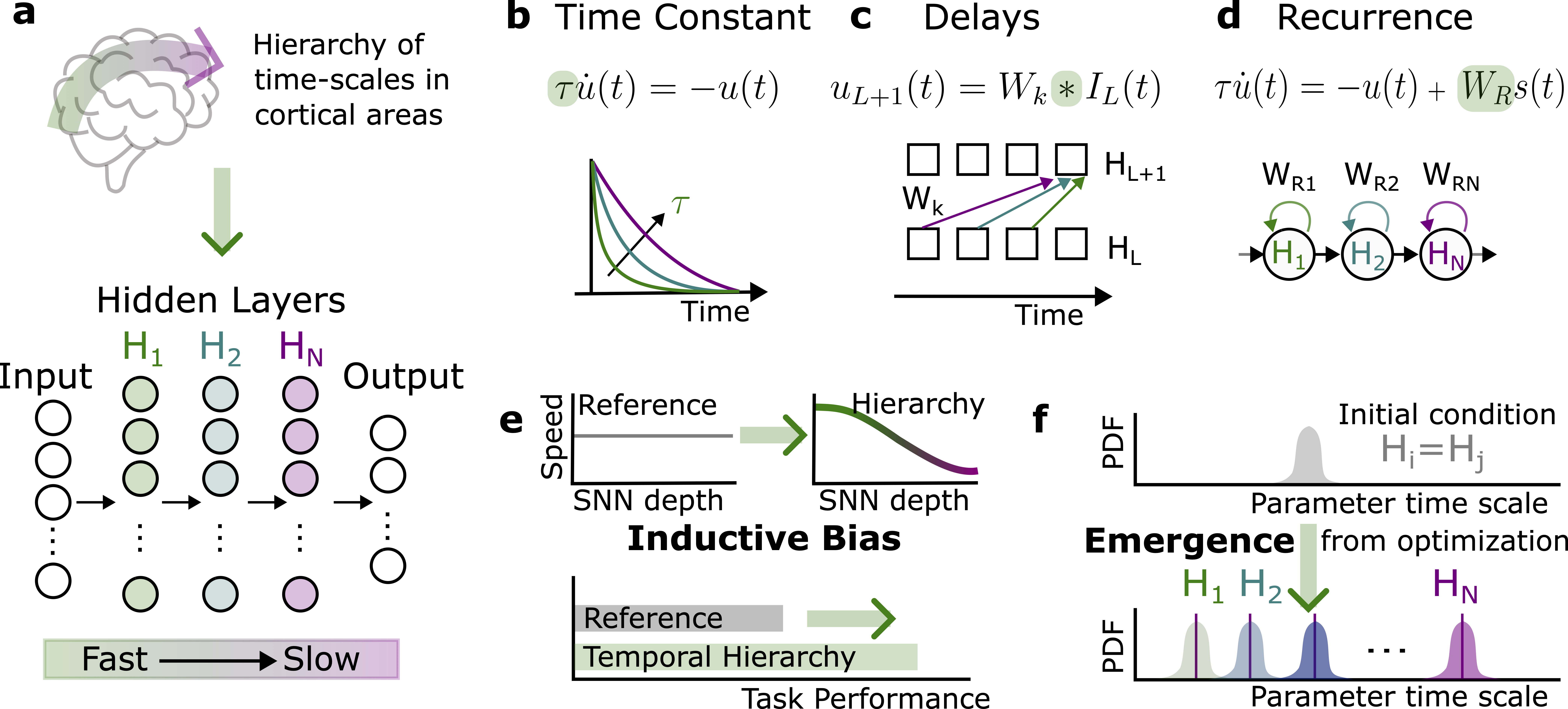
The hierarchy of time-scales is reproduced in SNNs leveraging neuronal dynamics, delays and recurrent connections. The hypotheses are that the hierarchy is both a positive inductive bias and an emerging property from optimization.
Two hypotheses
We formulate two hypotheses. First, that temporal hierarchy acts as a useful inductive bias: initializing SNNs with a structured progression of time scales — fast in early layers, slow in deeper ones — should improve classification accuracy over a reference model with homogeneous time constants. Second, that temporal hierarchy emerges naturally from optimization: when time constants are left free to be learned via backpropagation, gradient descent should discover a hierarchical arrangement on its own, without any explicit prior.
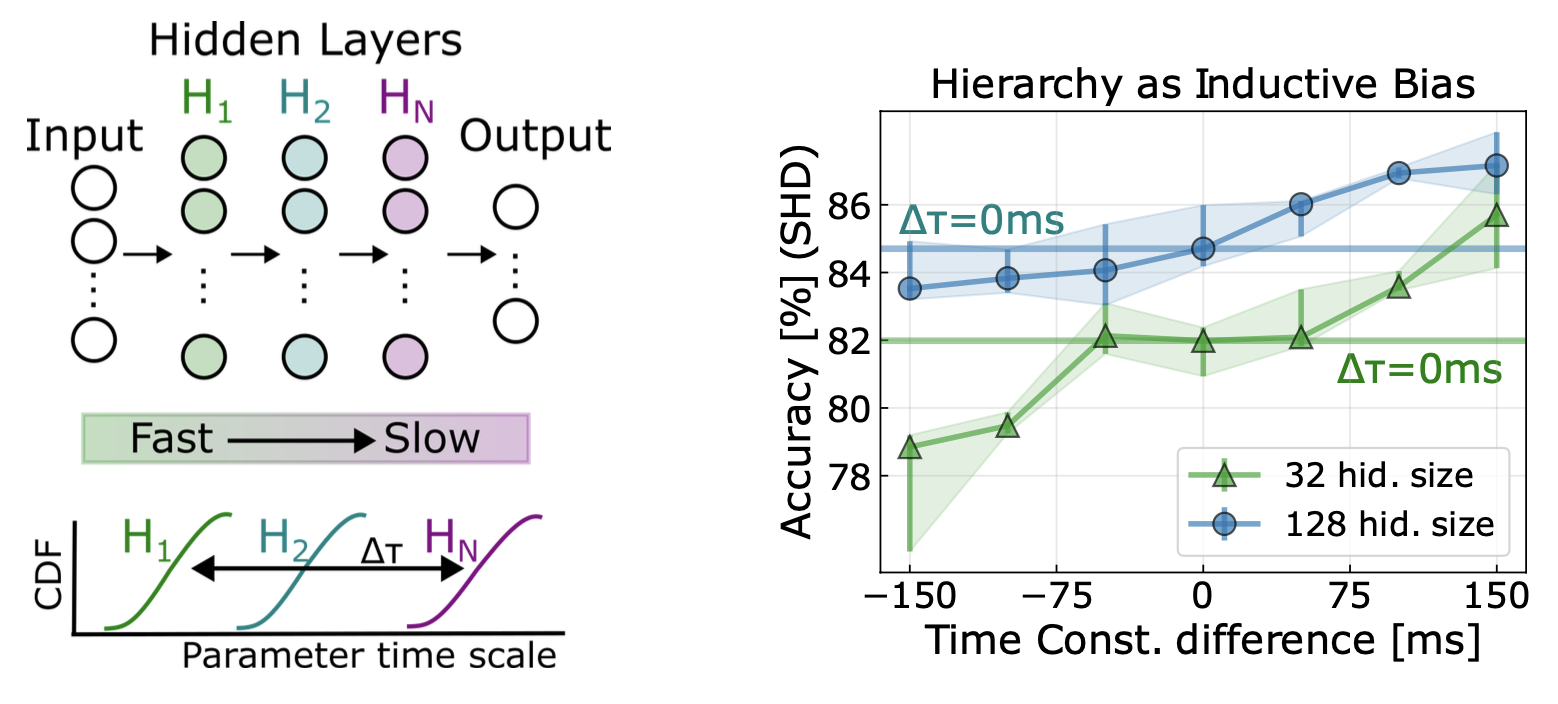
The experiments in a keyword spotting task, forming a hierarchy of time constants in SNNs, show the positive effect of such Inductive Bias on task performance.
The benefits of Temporal Hierarchy
Both hypotheses are confirmed. As an inductive bias, a hierarchy of time constants and synaptic delays yields accuracy gains of 2–6% on keyword spotting and multi-timescale tasks, with the benefit most pronounced in smaller networks — reducing the required parameter count by up to 5× for the same target accuracy. In the optimization setting, gradient descent reliably discovers a fast-to-slow progression of time constants and recurrent eigenvalues across layers, confirming that temporal hierarchy is not merely a useful prior but a naturally preferred solution when learning temporal tasks. Together, these results establish temporal hierarchy as a principled and transferable architectural feature for efficient SNN design, with direct implications for resource-constrained neuromorphic computing.
Recommended citation: F. Moro et al. (2024). "The Role of Temporal Hierarchy in Spiking Neural Networks." ArXiv. 1(2).
Download Paper