DenRAM: neuromorphic dendritic architecture with RRAM for efficient temporal processing with delays
Published in Nature Communications, 2024
Taking inspuration from dendritic arbors
Biological neurons are far more computationally powerful than the simplified “point neuron” models commonly used in artificial neural networks. A key yet often overlooked contributor to this power is the dendritic tree: the branching structure through which neurons receive their inputs. Dendrites do not merely relay spikes passively — they introduce propagation delays that allow a neuron to detect temporal correlations across its inputs, a mechanism known as coincidence detection. Inspired by this principle, we present DenRAM, a neuromorphic feed-forward spiking neural network architecture that explicitly incorporates dendritic compartments and synaptic delays, enabling rich spatio-temporal processing without the need for recurrent connections.
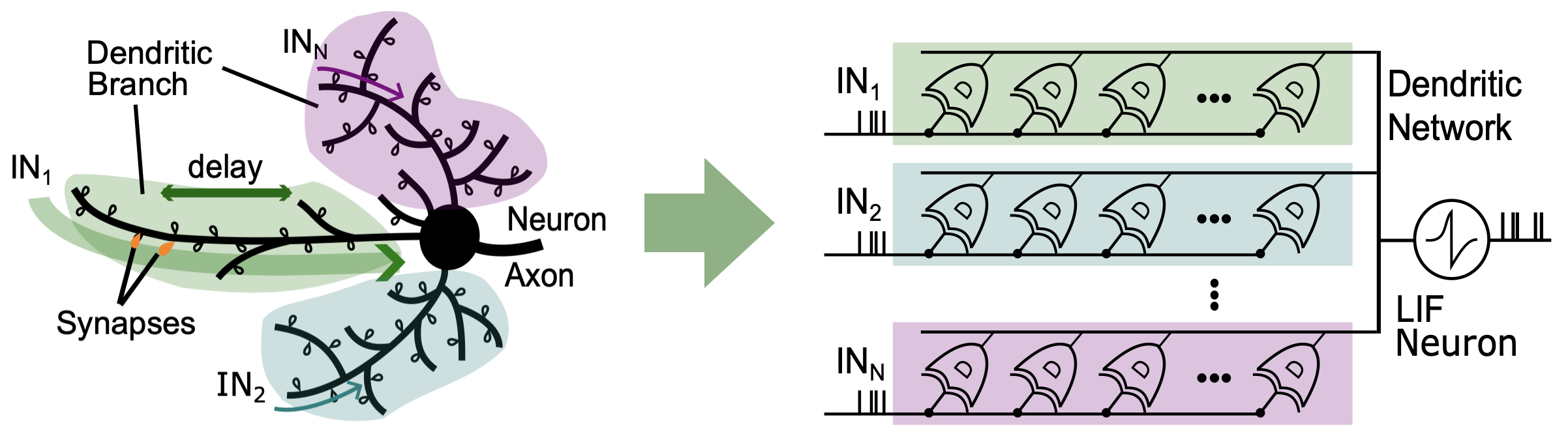
DenRAM mimics dendritic arbors with synaptic elements that delay and weigh input spikes, converging to an output Leaky-Integrate-and-Fire neuron.
The DenRAM architecture
To realize delays and synaptic weights compactly on chip, DenRAM leverages Resistive RAM (RRAM), an emerging non-volatile memory technology integrated on top of a 130 nm CMOS process. Each dendritic circuit uses two RRAM devices per synapse: one sets the RC time constant that controls the propagation delay, while the other modulates the synaptic weight. Because RRAM devices are non-volatile and consume zero static power, this design minimizes both area footprint and leakage power compared to purely active analog or digital delay implementations. Crucially, DenRAM exploits the natural device-to-device variability of RRAM to provide a rich spectrum of delays across the dendritic array, turning hardware heterogeneity from a challenge into a computational asset.
We benchmark DenRAM on two representative edge-computing tasks: ECG heartbeat anomaly detection and keyword spotting on the Spiking Heidelberg Digits dataset. On the heartbeat task, DenRAM achieves 95.3% accuracy with only 16 parameters — 35× fewer parameters than an iso-accuracy spiking recurrent neural network (SRNN) — and consumes 5× less power (5.30 nW vs. the equivalent SRNN). On the keyword spotting task, DenRAM reaches up to 87.5% accuracy under realistic RRAM noise conditions, consistently outperforming recurrent architectures with the same parameter budget. Together, these results demonstrate that dendritic delays are a powerful and hardware-friendly inductive bias for temporal sequence processing.